Before analyzing social relations, it is good to deal with the new paradigm. But how should this “new” be constructed? It is the question from which the philosopher will start Pierangelo Di Vittorio, in the third appointment of the training course “Volunteers and families online for mental health”, scheduled for Saturday 24 October, at the Di Liegro Foundation.
The answer - according to Di Vittorio - is in putting together pieces of the past, in the form of cultural archives, and pieces of the present, that is, diagnoses on the problems and tensions that run through current affairs. A type of mosaic, made up of pieces on which Di Vittorio has been working for some time, collected starting from the question of social relations.
And it is like in a mosaic that the themes of the meeting will be composed, between the philosopher Walter Benjamin and the present which has “the power of the keys over the rooms of the past” and the writer and philosopher Michel Foucault, who has dealt with madness since his doctoral thesis "History of madness in the classical age" and invited us to question ourselves precisely on madness, because "from man to true man, the road passes through the mad man" .
During the meeting we will inevitably talk about Franco Basaglia (with whom Pierangelo Di Vittorio came into indirect contact when after graduating he carried out his civil service at the Mental Health Department of Trieste) and of his decision to undertake the path of invention and caring for the social bond. Read about it in this regard monograph "Franco Basaglia", written with Mario Colucci, released in 2001 and recently re-edited.
“Began in the name of a love for knowledge, in the name of philosophy, Basaglia's experience developed as a loving relationship towards patients, to finally be realized in the construction of another way of living together. A more just and fruitful common life – Di Vittorio wrote in the magazine “Either/Or” in 2017 – for which Italian society and the entire world still bear the responsibility and active hope”.
How many times do we hear a banal "How are you?", often followed by an equally banal "fine, thanks"? Countless times. In reality, in this question there is a relationship proposal behind which there can be many nuances that lead to entering into a relationship with another person. And if, for example, that other person is a homeless patient who is suffering the consequences of the lockdown on the street and has lost the little relational openness that he had built up to the point of completely neglecting his state of health and his discomfort, that 'how are you' (or even a 'how are you' or a 'what's up') can become the first step towards approaching healthcare facilities.
This is how it began How are you? Distancing, isolation and loneliness, the second meeting of training course "Volunteers and families online for mental health" of the Di Liegro Foundation. Speaker, Dr. Massimiliano Aragona, psychiatrist, psychotherapist and philosopher, coordinator of the SIMM, “Mental Health and Immigration” group of the Italian Society of Migration Medicine.
Inevitably, COVID-19 was at the center of his speech and of the interventions of the participants in person and online, volunteers and people active in the third sector.
Even inside homes, the total lockdown represented a shock, the change in our lifestyle that did not conceive of social distancing, the ban on physical relationships. Many have suffered profoundly, but there have been many who have appreciated some aspects: the cleaner cities and air, the canceled traffic, the respected queues, the empty cinemas.
Confirm that in every situation – even in what 60 million Italians are experiencing at the same time, each in their own way – there are resilience factors, unexpected opportunities which, if taken from the right side, can lead to positive developments. For example, forcing us to ask ourselves the question: "What is really important in life?".
But ultimately, the lockdown improved things in the communities, family first and foremost, where things were going well and worsened in those where they were going badly.
Surprises came from several people suffering from particular mental disorders, who enjoyed sharing the rules with everyone else.
During the crisis, the Third Sector continued to be present, demonstrating how important it is in society.
The Public Service as a whole has had many problems. The pandemic was a stress test for a system that showed its flaws. Health facilities responsible for the treatment of mental illnesses closed their doors in the face of the threat of the virus: patients who were outside were not able to enter, those who were inside were not able to leave, remaining closed together with the health workers for a month/a month and a half , away from family, often without explanations about what was happening. Some coped well, others didn't.
And now there is the second wave. For better or worse we were all waiting for it and we knew we had to prepare, but here we are all still in the same boat with anxiety rising.
It's a different phase. There probably won't be a second total lockdown, lethal for the economy, but there is a lack of clear indications and rules for everyone and each of us will have the task and burden of seeking the right behaviors.
Covid didn't stop us and the XIV edition of the Di Liegro Foundation's "Volunteers and families online" training course began on the theme of "Starting again from the crisis" on 3 October. We will continue until December 5th: for us, training and in-depth study on the topic of volunteering are an unmissable event.
The virus has profoundly changed the way we gather: shadowing is prohibited. A small group of course participants, appropriately distanced, meets in our office. The others are connected online. Technology creates a virtual presence that does not make us miss the real one too much and offers new opportunities: this year people who live in different parts of Italy, from Sicily to Lombardy, of different ages and experiences are taking part in the course.
Their stories revealed how strong the impact of the lockdown was on the world of volunteering. Consolidated experiences in supporting the most fragile part of the population have been faced with a challenge. Barred the doors of the hospital wards where pediatric patients, cancer patients and lonely elderly people are helped. Stop the workshops where people with mental disorders find space to enter into relationships with others and express themselves. Adolescents with Down syndrome, in particular, have suffered greatly, as have their families.
Volunteering has reacted to isolation by moving to the digital network, discovering that many people, especially young people, open up more in virtual communication, but also that there are still many who do not have access to the web.
There is a divide between those who have access to IT tools and those who do not, but 95% of the population owns a smartphone and there is also room for volunteering there.
The sociologist is convinced of this Andrea Volterrani, the first speaker of our training course Volunteers and families networking for mental health. Physical proximity is in many cases irreplaceable, but building relationships of reciprocity and trust, which are the basis of a community, it is also possible on the network. Anyone approaching volunteering must know that it takes time and that you cannot be alone. Individual volunteering does not exist. It is the group, the collective, that is successful, even online.
We are all in a community when we build relationships in the same space and for a certain period of time. We should also start from the concept of community when talking about volunteering and the consequences of the pandemic.
This is the theme of the first meeting of the training course “Volunteers and families online for mental health”, entitled "Volunteering and community, starting again from the crisis", scheduled for Saturday 3 October 2020, at 10.30 am, with Andrea Volterrani, sociologist, researcher and professor at the University of Rome Tor Vergata.
SIGN UP FOR THE TRAINING COURSE FOR NETWORK VOLUNTEERS FOR MENTAL HEALTH
Professor Volterrani, who deals with research, training and consultancy on social policies, the third sector, social communication, evaluation of the added social value and impact of the third sector, new forms of mutuality and subsidiarity and resilient communities, is the author of numerous publications, including (with Paola Tola and Andrea Bilotti) The taste of volunteering. For Volterrani, volunteering must be pleasure and not duty or suffering, rather a distinctive work and not the gratification of having given help.
For this, a change of mentality is necessary, trying to grow social capital within a community, emancipate it and, only later, seek financial support for the projects. In short, a reversal of common practice, in which the community should first be emancipated and then the services built, providing it with the necessary tools.
During the meeting "Volunteering and community, starting again from the crisis", Andrea Volterrani will also address the topic of the use of digital media to increase inclusion in communities. We cannot ignore technological tools, but we can use them as opposed to the usual individualization, for achieve social inclusion and imagine alternative spaces for intelligent and conscious digital communities.
SIGN UP FOR THE TRAINING COURSE FOR NETWORK VOLUNTEERS FOR MENTAL HEALTH
Photo by God Hasbi Saniskoro from Pexels.
The news of recent weeks tells us how the link between the pandemic and mental health is increasingly close. On the one hand, the COVID-19 emergency has forced healthcare facilities to put, for example, the treatment of certain chronic diseases or mental health services on the back burner. On the other hand, it has increased the isolation of people with mental problems and their families.
The case of Caronia, with the escape of Viviana Parisi, her death and that of little Gioele, testifies in fact how the lockdown triggered the disease and how the failure to accept and take charge of it resulted in tragedy.
Assisting a terminally ill patient in solitude night and day, protecting a mentally ill person without adequate support, dealing with the unpredictable economic consequences of the health crisis, making oneself useful in alleviating the isolation of others, of a family member, of an elderly neighbor, of one's neighbor: they are these are some of the testimonies we have collected in these months of activity.
The 14th edition of the training course "Volunteers online for mental health" was born from the link between pandemic and mental health, organized by the Di Liegro Foundation, which this year has the theme "From isolation to resilience. The role of volunteering".
FROM ISOLATION TO RESILIENCE. THE ROLE OF VOLUNTEERING: PROGRAM
The lessons of the course “From isolation to resilience. The role of volunteering" will be held on Saturday, from 10.30 to 12.30, at the headquarters of the Di Liegro Foundation, in via Ostiense 106, in Rome (Metro B stop Garbatella).
FIRST MEETING – 3 OCTOBER 2020
VHELP AND COMMUNITY: STARTING AGAIN FROM THE CRISIS
Luigina Di Liegro, General Secretary of the Di Liegro Foundation
Andrea Volterrani, Sociologist, researcher and teacher at the University of Rome Tor Vergata
SECOND MEETING – 17 OCTOBER 2020
HOW ARE YOU? DISTANCING, ISOLATION AND SOLITUDE
Massimiliano Aragona, psychiatrist and philosopher
THIRD MEETING – 24 OCTOBER 2020
SOCIAL RELATIONSHIPS, A NEW PARADIGM
Pierangelo Di Vittorio, philosopher and writer
FOURTH MEETING – 7 NOVEMBER 2020
RESILIENCE AS A MENTAL HEALTH TOOL
José Mannu, Psychiatrist
FIFTH MEETING – 21 NOVEMBER 2020
STRESS AND TRAUMA, REBORN FROM DISCOMFORT
Silvia Pepe, Psychologist and psychotherapist at the Institute of Relational Psychotherapy
SIXTH MEETING – 28 NOVEMBER 2020
ADDICTIONS AND LIFESTYLES DURING THE PANDEMIC
Giuseppe Ducci, Director of DSM ASL Roma1
Alessandro Vento, Psychiatrist, CSM ASL Roma2
SEVENTH MEETING – 5 DECEMBER 2020
THE ROLE OF THE VOLUNTEER. REFLECTIONS, METHODOLOGIES, EXPERIENCES
Michele Di Nunzio, Psychiatrist UOC SPDC San Filippo NerI
The participation fee for the course is €35, for university students €25.
Register to participate in the training course
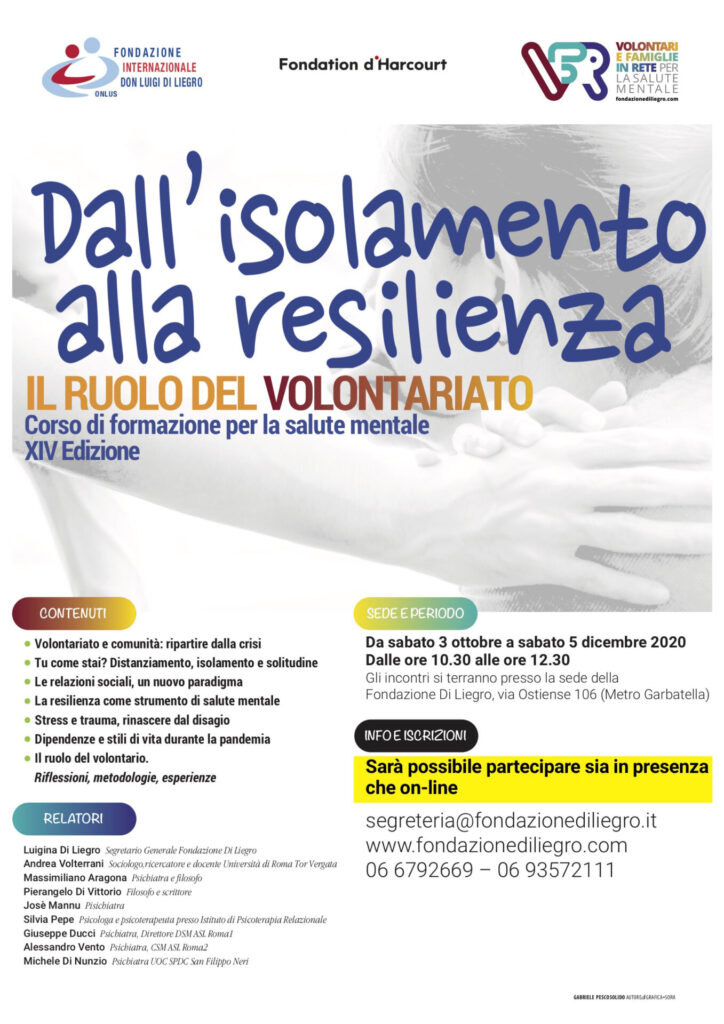
The 14th edition of the training course kicks off on October 3rd "Volunteers and families online for mental health", This year's theme is "From isolation to resilience. The role of volunteering". For fifteen years, volunteer training and orientation on mental health have in fact been the main vocation of the Don Luigi Di Liegro Foundation.
Register to participate in the training course
The pandemic has shaken the foundations of our daily life: health emergency, economic crisis and social problems have determined and exacerbated tensions whose future developments we do not know. Resilience has thus become an indispensable ability to adapt to guarantee quality of life and protect mental health put to the test by these latest events.
Among the "groups" in difficulty and about which little is said is that of volunteering. The pandemic crisis has led to the closure of several third sector organizations and the interruption of their activity risks depriving the community of the services offered so far. Yet, today more than ever, the contribution of volunteers who embody and bear witness to an indispensable value in the reality of their actions is indispensable: the gift.
A society without the culture of giving is destined to ignore the value of man which instead finds exaltation in the civil practice of the spirit of volunteering. Volunteering is one of the noble tools available especially to young people to contribute to the construction of a civil society. Learning to give yourself to others will allow those who tomorrow will be a doctor, a worker, a lawyer to live their experiences with a different, more supportive spirit. This is the value of a gift and it is this wealth that motivates volunteers to make sacrifices with a light heart.
The lessons of the course "From isolation to resilience. The role of volunteering" will be held on Saturday, from 10.30 to 12.30, at the headquarters of the Di Liegro Foundation, in via Ostiense 106, in Rome (Metro B stop Garbatella).
It will be possible to participate both in person, while places are available, and on a digital platform.
Register to participate in the training course
FIRST MEETING – 3 OCTOBER 2020
VHELP AND COMMUNITY: STARTING AGAIN FROM THE CRISIS
Luigina Di Liegro, General Secretary of the Di Liegro Foundation
Andrea Volterrani, Sociologist, researcher and teacher at the University of Rome Tor Vergata
SECOND MEETING – 17 OCTOBER 2020
HOW ARE YOU? DISTANCING, ISOLATION AND SOLITUDE
Massimiliano Aragona, psychiatrist and philosopher
THIRD MEETING – 24 OCTOBER 2020
SOCIAL RELATIONSHIPS, A NEW PARADIGM
Pierangelo Di Vittorio, philosopher and writer
FOURTH MEETING – 7 NOVEMBER 2020
RESILIENCE AS A MENTAL HEALTH TOOL
Jose Mannu, psychiatrist
FIFTH MEETING – 21 NOVEMBER 2020
STRESS AND TRAUMA, REBORN FROM DISCOMFORT
Silvia Pepe, psychologist and psychotherapist at the Institute of Relational Psychotherapy
SIXTH MEETING - 28 NOVEMBER 2020
ADDICTIONS AND LIFESTYLES DURING THE PANDEMIC
Giuseppe Ducci, Director of DSM ASL Roma1
Alessandro Vento, psychiatrist, CSM ASL Roma2
SEVENTH MEETING – 5 DECEMBER 2020
THE ROLE OF THE VOLUNTEER. REFLECTIONS, METHODOLOGIES, EXPERIENCES
Michele Di Nunzio, UOC SPDC psychiatrist San Filippo Neri
The participation fee for the course is €35, for university students €20.
The payment takes place in the form of a donation to the Don Luigi Di Liegro International Foundation and is therefore deductible from the tax return. Payment can be made via:
Register to participate in the training course
Starting from 19 October, the 13th edition of the usual training course "Volunteers and families online for mental health" promoted by the Foundation will be held, entitled: "Lifestyles for well-being in adolescence". Nine meetings aimed at those interested in learning more about mental health volunteering.
In particular, this year's theme focuses onadolescence and lifestyles for well-being. The protagonist will be the network of relationships and the experiences lived by the adolescent; networks which, in addition to being psychological and emotional, are also cultural and social: family, school, peer group.
The meetings will be held at headquarters of the Di Liegro Foundation, in via Ostiense, 106 - Montemartini Central Entrance - The headquarters is easily reachable by public transport: Garbatella line B metro stop.
Download the meeting programme
To register:
Fill in the form downloadable to send to segreteria@fondazionediliegro.it
Or
sign up online by clicking here
The cost of the entire course is 50 euros. It can be paid on the first day of the course.
Saturday 23 November The third meeting of our usual training course was held. This year's focus is on Lifestyles for well-being in adolescence.
The chairs in a circle. Parents, relatives, psychologists, psychotherapists, students, social workers. The theme is adolescence in the family life cycle. The dialogue starts from a video with i first-person stories of young people who live with discomfort, sometimes with a psychological disorder, the difficult process of transformation that leads to adulthood.
Then the parents - the vast majority are mothers - they talk about their troubled paths, which in several cases begin from their own problematic adolescence, marked by dysfunctional parents. The gray areas that emerge thin out in the group, which listens, understands, condivide, supports, suggests, accompanied by the experts present.
Change your perspective, find the courage to transform your ideas, change your gaze on your children, trust them, stay with them for overcome fear together of living that concerns everyone: adolescents, parents, operators. Because fear is always accompanied by hope, hope that there is still time, that we can succeed.
The next meeting, Saturday 30 November, will have the theme of health through integration. We look forward to seeing you for another moment of personal and collective growth.


Il 24 ottobre, dalle 15.00 alle 18.00, si terrà la tavola rotonda Economy Around Humanity - 2030 Agenda Goals' Tools. Mercato Privato e Terzo settore danno vita alla prima piattaforma di comunicazione Digitale e Social Resposanbility.
L'idea del progetto è quella di creare un sistema di network tra Aziende pubbliche, private e del Terzo Settore; mirando alla realizzazione di un'innovazione sostenibile di rete, si propone la realizzazione di quattro obiettivi in altrettante aree di interesse.
Durante la tavola rotonda, insieme ai primi contributori (Diversity Opportunity, Arkage, Croce Rossa Italiana, DiTES, HUMAN FOUNDATION, CARIS, DRESS FOR SUCCESS Rome, discuteremo di:
Economy Around Humanity – 2030 Agenda Goals’ Tools apre il dialogo ad un confronto diretto e connesso, immediatamente operativo, attraverso metodi e tools della nuova tecnologia.
Venerdì 27 settembre, dalle ore 18 alle 20.30, la Fondazione Don Luigi Di Liegro ospiterà l’anteprima romana del BodyMindDialogue® (BMD), metodo per la crescita personale della scuola di counseling WinnerTeam.
L’incontro, che sarà condotto dalla docente Paola Poluzzi, è gratuito e rivolto a tutti coloro che desiderano sperimentare un’esperienza di consapevolezza corporea fondata su movimento, danza, visualizzazione interiore, tecniche di meditazione e respirazione. Con l’approccio integrato di auto-percezione del BMD è possibile migliorare il rapporto tra la mente, il corpo e le emozioni, considerati nella loro dimensione di aspetti diversi della nostra unicità, in un percorso di sostanziale auto-formazione.
Consigliato a tutti, il BMD può essere utile anche a chi opera nel campo del benessere e delle relazioni d’aiuto e potrà essere praticato a Roma nel corso annuale di imminente attivazione che verrà presentato in occasione dell’incontro del 27 settembre.
Per partecipare occorrono soltanto curiosità e indumenti pratici, prenotando prima alla Segreteria della Fondazione Don Luigi di Liegro (segreteria@fondazionediliegro.it, tel. 066792669 - 0693572111). Ci si può iscrivere online qui: http://bit.ly/BMD_ISCRIZIONE
Per informazioni è inoltre disponibile la docente Paola Poluzzi al cell. 349 2530646.